Brief overview
A rubric is a scoring tool that outlines the key criteria for assessing an assignment or activity. It defines specific levels of achievement in objective and measurable ways, making clear the expectations for student work based on specific criteria. Rubrics can be used to assess multiple types of student work, such as essays, group or individual projects, creative endeavors, and presentations. Rubrics reduce grading time, increase grading transparency, and support objective and consistent grading.
Parts of a rubric
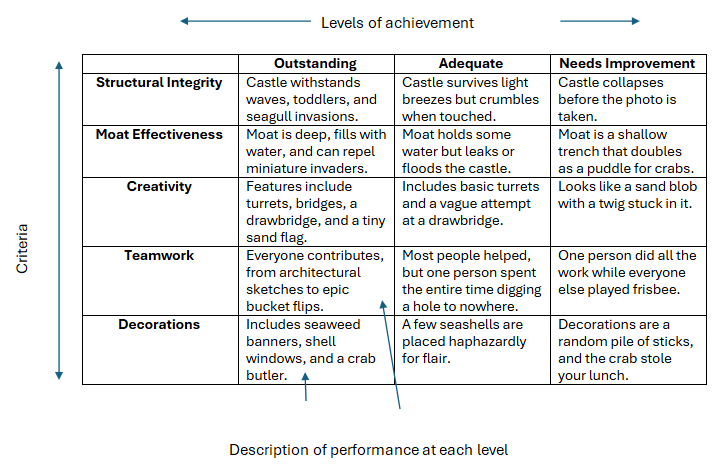
Types of rubrics
Analytical
The rubric shown above is an example of an analytical rubric.
Description: Breaks down characteristics into parts; itemized and defines exactly what is done well and areas for improvement
Advantages: Provides clear picture of how a score is achieved; consistency in grading
Disadvantages: Takes time to create and may need multiple iterations
Holistic
| Score | Description |
| 3 | All food is perfectly cooked, presentation surpasses expectations, and recipient is kept exceptionally comfortable throughout the meal |
| 2 | Some food is cooked poorly, some aspects of presentation are sloppy or unclean, or the recipient is uncomfortable at times |
| 1 | Most food is cooked poorly, presentation is sloppy or unclean, and recipient is uncomfortable most of the time |
Description: Very general with broad description of characteristics per level
Advantages: Quick to create and grade
Disadvantages: Each quality cannot be given separate scores; lack of targeted feedback
Single point
| Concerns
Areas that need work |
Criteria
Standards for this performance |
Advanced
Evidence of exceeding standard |
| Food: All food is at the correct temperature, adequately seasoned, and cooked to the eater’s preference | ||
| Presentation: Food is served on a clean tray, with napkin and silverware. Some decorative additions may be present. | ||
| Comfort: Recipient is woken gently, assisted in seat adjustment, and given reasonable time and space to eat. |
Description: Breaks down components into criteria; only provides details for proficient level
Advantages: Quick to create; provides feedback to students on strengths and opportunities; encourages growth-orientated feedback by removing focus from grades and points
Disadvantages: Takes time to score due to time to provide feedback; more subjectivity and less consistency
Tips
- Limit rubric to a single page
- Use parallel language: Use similar language from column to column
- Avoid negative mindset by focusing on what students do, rather than what they did not do
- Maximize descriptiveness of language
- Consider adapting pre-existing surveys to meet needs, such as the VALUE rubrics or those found in databases at other institutions, such as University of Hawaii and University of Wisconsin-Stout.
Resources
Andrade, H. G. (2005). Teaching with rubrics: The good, the bad, and the ugly. College Teaching, 53(1), 27-30. https://www-jstor-org.ezproxy.lib.uconn.edu/stable/27559213?sid=primo&seq=1
Gonsales, C. (2023). Improving learning through assessment rubrics: Student awareness of what and how to learn. Information Science References
Stevens, D.D. (2012). Introduction to rubrics: An assessment tool to save grading time, convey effective feedback, and promote student learning. Routledge.
Rhodes, T.L. (2010). Assessing outcomes and improving achievement: tips and tools for using rubrics. AAC&U.
HuskyCT rubric resources
Creating and importing rubrics